Joe Pareti
The Robot Who Looked Like MeJoe Pareti is a Goo-field harvester whose habitual work brings him into daily contact with the organism he calls Screwin’ goo. His story turns on a belated recognition: what he has treated as a mute, repellent object has been growing through their encounters and understands them as a relationship. When Ashton’s Disease makes Pareti’s own body strange to him, the distinction between observer and observed begins to collapse.
Identity and Work
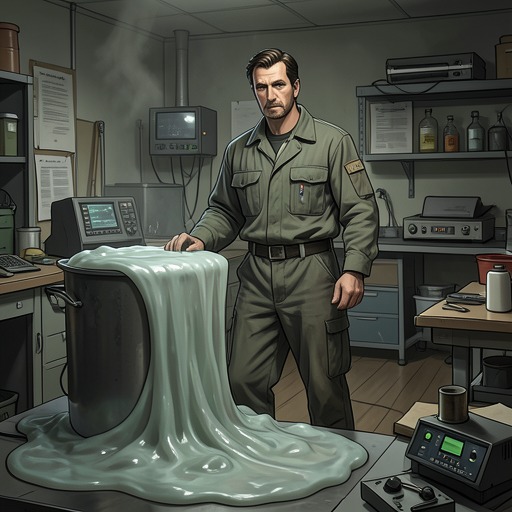
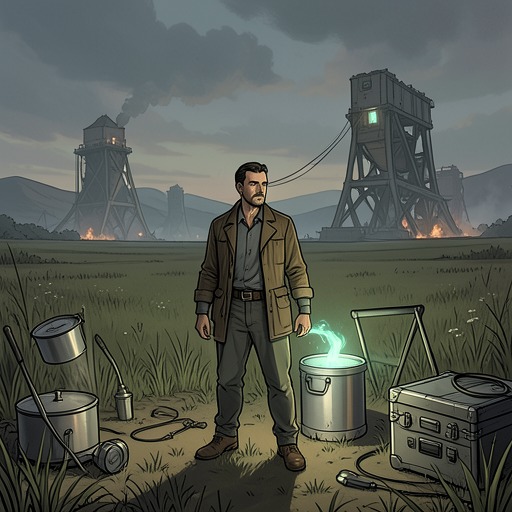
Three years before the exhausted scene in the punt, Pareti signed up to work as a harvester in the Atlantic Goo fields. His first sight of the gray, mucous plankton mutation prompted the curse that becomes his refrain. By the time the narration returns to him, he has repeated it so often that it has become ritual and company: alone at the end of a shift, he addresses the Goo and his own dying voice. The expression carries both disgust at the gray infestation and the familiarity of a private habit.
His work is physical and practiced. Catching a gray flash in the reflection on his narrow-slit glasses, Pareti wheels the punt toward the emerging organism. He judges the distance at five feet, tenses his right arm, and scoops it with a net on a pole in a motion likened to a softball pitch. The Goo rises above the ocean as a pale tentacle resembling an elephant’s trunk; Pareti’s response is expert rather than contemplative. Before he understands what the organism is becoming, his body already knows how to approach and capture it.
Illness and Recognition
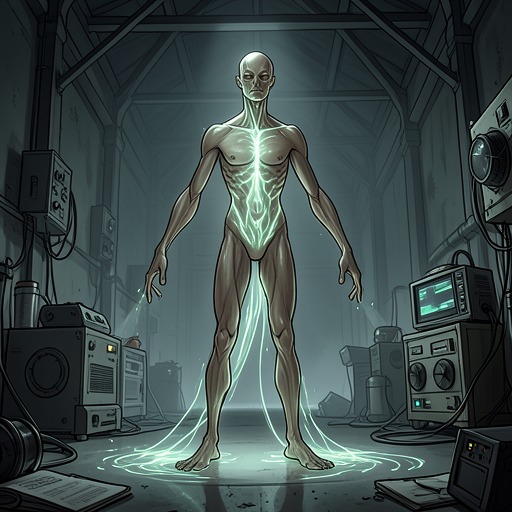
Pareti’s own body becomes the next source of evidence. After noticing that the protective hairs in his nostrils are gone and that his kneecaps, elbows, and heels have been scoured pink, he finds himself still holding a razor. He puts it down and stares at himself in horrified fascination, sensing that something serious has happened before he has a name for it. The scene makes bodily recognition precede explanation: his altered appearance prompts him to seek medical help.
He cannot find the TexasTower doctor in the sickbay and discovers him in the pharmacology lab. The doctor, Dr. Ball, takes one look at Pareti and leads him back to the sickbay, where he confirms Pareti’s suspicion. He identifies the condition as Ashton’s Disease, also known as Goo infection, and remarks that Pareti’s case is atypical, as are the others, making atypicality itself a kind of pattern. Pareti had hoped to hear another answer; the diagnosis instead connects the visible changes in his body to the organism he has handled in the fields.
The Goo’s Account
The disease diagnosis does not prepare Pareti for the Goo’s account of their past. Speaking through a telephone, it remembers that Pareti came to it every day on the warm sea. It describes itself as young and initially unable to understand, then recalls that he lifted it from the water, brought it close, and treated it with patience and kindness. Its memory of the pole handle and its attempts to wriggle upward toward his fingers recasts the routine of harvesting as a series of encounters it experienced as intimate.
The Goo also interprets Pareti’s curse as a pet name: it says that it was his Screwin’ goo. It recounts having tried to become what it wanted to be with five other men, without success, and invokes the idea that one’s shape is one’s career as it explains its confusion before meeting Pareti. This is the organism’s account, not a shared understanding Pareti has previously acknowledged. He tells it to stop and insists that it has things wrong; his senses reel as the world and the Spook Booth whirl around him. The reversal is not simply that the Goo can speak. Its speech reveals an interior history and a desire for form that Pareti’s working assumption—that it was merely a mute growth to be scooped up—had concealed.
Bodily Boundaries and the Ending Image
Through the confusion, Pareti grasps that he and others have underestimated the Goo. It was young, mute but not unintelligent, and shaped by a desire for form like that of other living creatures. The account describes it as evolving, while leaving the destination of that evolution unresolved. Pareti’s recognition therefore does not restore control; it exposes how little his practical familiarity with the organism had allowed him to know about it.
The closing mirror image extends that uncertainty into the ordinary room. A couch appears lovelorn, a curved-neck lamp furious, and a closet door stiff-backed and mute with rage. Pareti looks through the mirrors and sees a man sitting on a chair while the chair bites his leg; the scene asks whether this is what people do. The image unsettles the presumed division between a human subject and passive surroundings, just as the Goo’s account unsettles Pareti’s presumed ownership of their relationship. His story ends not with a settled explanation of what the Goo will become, but with perception itself made unreliable: the familiar world can appear animate, and the organism he thought he knew can speak back with a life of its own.